Strength Training Explained: Build a Stronger Foundation
Understand what strength training is, how the main training variables fit together, and where to begin without turning your program into a maze of methods.
This hub connects beginner training, exercise technique, program design, training plans, muscle anatomy, and physiology. Use it as your central route into the strength-training content on Fitness Simply Explained.

What is strength training?
Strength training, also called resistance training, means repeatedly working against resistance created by machines, free weights, cables, bands, body weight, or other equipment. Depending on how the program is designed, it can improve muscle strength, muscle size, power, muscular endurance, balance, and physical function in healthy adults.1
There is no single universally best routine. A large network meta-analysis found that all studied resistance-training prescriptions improved strength and hypertrophy compared with no resistance training, while heavier loads were especially useful for maximizing strength and multiple sets ranked highly for hypertrophy.2
Where should you start?
Begin with the question closest to your current need. The routes connect, so you can move between technique, programming, exercises, and plans without losing context.
Begin strength training
Learn how a manageable beginner routine can be organized and what to prioritize during the first weeks.
Understand programming
Connect goals with exercise selection, sets, repetitions, load, rest, frequency, and progression.
Improve exercise technique
Use setup, movement control, range of motion, effort, and warning signs to review an exercise more systematically.
Browse strength exercises
Find exercise categories and connect movement execution with the muscles and body regions involved.
What strength training can improve
The outcome depends on the starting point, the program, the training dose, recovery, and consistency. These are possibilities—not guarantees for every person.
Muscle strength
Progressive resistance training can increase the ability to produce force. Higher loads are particularly relevant when maximizing voluntary strength is the main goal.12
Muscle size
Resistance training can stimulate hypertrophy across a wide range of loading approaches when the training is sufficiently challenging and performed consistently.12
Power and performance
Programs designed around rapid force production can improve power, while progressive resistance training can also support several physical-performance outcomes.1
Physical function
Evidence syntheses report improvements in outcomes such as gait speed, balance, muscular endurance, and broader physical function in healthy adults.1
The six decisions that shape a program
A training plan becomes easier to understand when each variable has a clear purpose instead of being treated as an isolated rule.
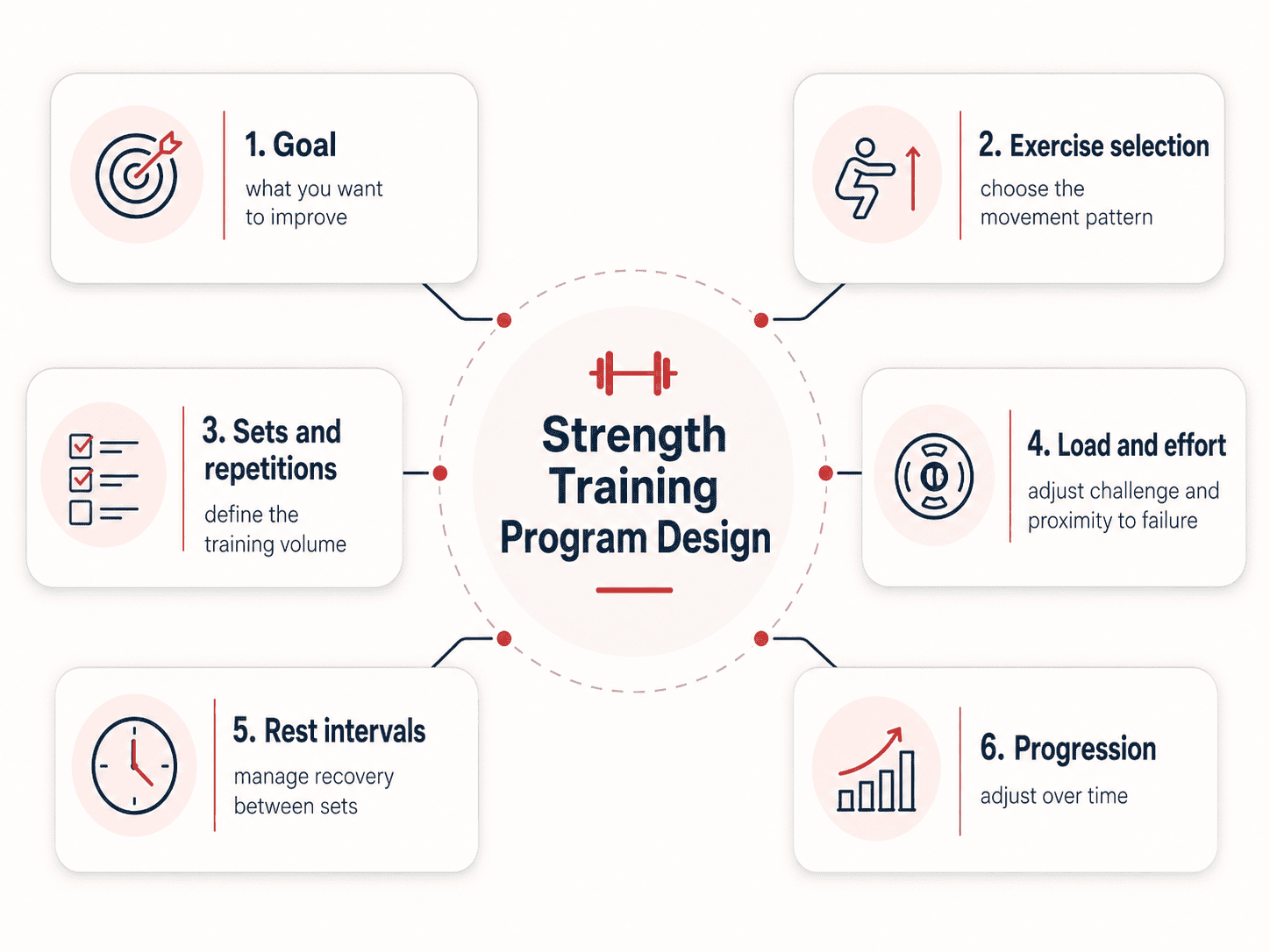
Define the main outcome
Decide whether the main priority is strength, muscle growth, power, muscular endurance, physical function, or a balanced general-fitness approach.
Select repeatable movements
Choose exercise variations that fit the goal, equipment, current ability, and available range of motion while remaining controllable.
Organize sets and repetitions
Sets and repetitions help determine how much work is performed. More is not automatically better; the dose must remain recoverable.
Choose load and proximity to failure
Training does not have to reach momentary muscular failure in every set. Strength can improve across a broad range of repetitions in reserve, while hypertrophy may be more sensitive to how close sets finish to failure.4
Recover between sets
Rest intervals should allow the next set to match the goal. Evidence on hypertrophy suggests a small advantage to resting longer than 60 seconds, with no clear additional benefit beyond roughly 90 seconds in the available studies.5
Increase the challenge over time
Progression can involve more load, repetitions, sets, range of motion, movement quality, or a harder variation. The next step should remain appropriate for the goal and current performance.
A simple order for your first weeks
This is a learning sequence rather than a universal prescription. Individual health, symptoms, experience, equipment, and goals may require a different starting point.
Start with two sessions
Two full-body sessions per week are a practical starting point for many healthy beginners and align with the WHO recommendation to strengthen the major muscle groups on at least two days per week.3
Open the beginner routineRepeat core movement patterns
Use a manageable selection of lower-body, pulling, pushing, and trunk exercises so that movement skill and performance can be compared across sessions.
Browse exercise categoriesKeep the effort controlled
Use loads that make the set challenging without requiring every repetition to be taken to complete failure. Movement quality and repeatability matter more than proving how hard one set can be.
Use the technique checklistProgress one variable at a time
Increase repetitions, load, or exercise difficulty when the planned work remains controlled. Evaluate progress across several weeks rather than one isolated workout.
Understand progression| Decision | Practical starting example | Why it may help | When to adjust |
|---|---|---|---|
| Frequency | Two full-body sessions per week | Simple schedule with recovery time between sessions | Increase only when recovery, time, and goals support it |
| Exercise count | About five to seven movements | Covers major patterns without making the session unnecessarily complex | Reduce if technique or session duration deteriorates |
| Work sets | One to three working sets per exercise | Allows a modest starting dose and room to progress | Add volume only when the existing dose is well tolerated |
| Effort | Challenging but usually short of complete failure | Supports repeatable technique and manageable fatigue | Adjust the load or variation when control breaks down |
On smaller screens, scroll the table horizontally. This framework is a practical educational example, not an individualized training prescription.
Current strength-training guides
These legacy English guides are already available and provide practical starting points. They will be updated progressively to the current editorial and design standard.
Beginner strength-training routine
A gym-based introductory plan with exercise selection, sets, repetitions, and a progression route for the first training phase.
- Beginner
- Full body
- Gym
Full-body workout without equipment
A simple circuit-style session for people who want a practical home-training option without a full gym setup.
- Home
- Bodyweight
- Full body
Programming strength training
An introduction to training methods and variables such as intensity, repetitions, rest, movement speed, and training frequency.
- Programming
- Methods
- Variables
Strength training becomes clearer in context
Exercise selection and progression make more sense when you understand the body, the physiological response to training, and the nutritional context.
Muscle anatomy
Connect exercise movements with muscle locations, joint actions, and practical training roles.
Exercise physiology
Understand fatigue, recovery, energy supply, muscle adaptation, and other processes behind training responses.
Nutrition explained
Place protein, energy intake, foods, nutrients, and supplements into a broader fitness context without diet hype.
Review exercise technique with a clearer structure
The free Exercise Technique Checklist gives you ten practical review points for exercise purpose, setup, movement control, range of motion, load, warning signs, and progression. The PDF is delivered after email confirmation.
Strength-training FAQ
These answers provide a starting framework. The best choice still depends on your goals, experience, health, equipment, and ability to recover.
How often should beginners do strength training?
Two full-body sessions per week are a practical starting point for many healthy beginners. The WHO recommends muscle-strengthening activity involving the major muscle groups on two or more days per week.3
Do I need free weights to become stronger?
No. Machines, free weights, cables, bands, and body-weight exercises can all create resistance. The useful option is the one that lets you train the target movement or muscle groups with appropriate effort and progression.
How many sets and repetitions should I do?
Do I need to train every set to failure?
No. Training to momentary muscular failure is not consistently required for strength or hypertrophy. The available dose-response evidence suggests that strength can improve across a wide range of repetitions in reserve, while muscle growth may be more sensitive to finishing sets closer to failure.14
How long should I rest between sets?
Rest long enough to perform the next set in a way that matches your goal. For hypertrophy, the available evidence suggests a small benefit to rest intervals longer than 60 seconds, but it did not identify a clear additional benefit beyond about 90 seconds.5 Heavy multi-joint sets may still require longer rests to maintain performance.
Can I build strength at home?
Yes. Body weight, resistance bands, adjustable dumbbells, or other suitable equipment can support effective training. The main challenge is ensuring that exercises remain sufficiently demanding and can be progressed over time.
References
- Currier BS, D'Souza AC, Fiatarone Singh MA, Lowisz CV, Rawson ES, Schoenfeld BJ, et al. American College of Sports Medicine Position Stand. Resistance Training Prescription for Muscle Function, Hypertrophy, and Physical Performance in Healthy Adults: An Overview of Reviews. Medicine & Science in Sports & Exercise. 2026;58(4):851-872. doi:10.1249/MSS.0000000000003897. PubMed.
- Currier BS, McLeod JC, Banfield L, Beyene J, Welton NJ, D'Souza AC, et al. Resistance training prescription for muscle strength and hypertrophy in healthy adults: a systematic review and Bayesian network meta-analysis. British Journal of Sports Medicine. 2023;57(18):1211-1220. doi:10.1136/bjsports-2023-106807. PubMed.
- Bull FC, Al-Ansari SS, Biddle S, Borodulin K, Buman MP, Cardon G, et al. World Health Organization 2020 guidelines on physical activity and sedentary behaviour. British Journal of Sports Medicine. 2020;54(24):1451-1462. doi:10.1136/bjsports-2020-102955. Journal page.
- Robinson ZP, Pelland JC, Remmert JF, Refalo MC, Jukic I, Steele J, et al. Exploring the Dose-Response Relationship Between Estimated Resistance Training Proximity to Failure, Strength Gain, and Muscle Hypertrophy: A Series of Meta-Regressions. Sports Medicine. 2024;54(9):2209-2231. doi:10.1007/s40279-024-02069-2. PubMed.
- Singer A, Wolf M, Generoso L, Arias E, Delcastillo K, Echevarria E, et al. Give it a rest: a systematic review with Bayesian meta-analysis on the effect of inter-set rest interval duration on muscle hypertrophy. Frontiers in Sports and Active Living. 2024;6:1429789. doi:10.3389/fspor.2024.1429789. PubMed.
Source Mapping
| Claim or content | Source | How it is used |
|---|---|---|
| Resistance training can improve strength, hypertrophy, power, endurance, balance, gait speed, and physical function in healthy adults. | Reference 1 | Short answer and outcomes section |
| All studied resistance-training prescriptions outperformed no training for strength and hypertrophy; heavier loads ranked highly for strength and multiple sets for hypertrophy. | Reference 2 | Short answer and FAQ |
| Adults should perform muscle-strengthening activity for all major muscle groups on at least two days per week. | Reference 3 | Public-health context and beginner frequency |
| Strength can improve across a broad range of repetitions in reserve; hypertrophy may be more sensitive to proximity to failure. | Reference 4 | Effort card and FAQ |
| For hypertrophy, rest intervals longer than 60 seconds may offer a small benefit, with no clear additional benefit beyond about 90 seconds in the available studies. | Reference 5 | Rest card and FAQ |
| The beginner example of two full-body sessions, five to seven movements, and one to three work sets is a practical educational framework rather than a universal protocol. | Editorial synthesis based on References 1-4 | Beginner pathway and example table |
On smaller screens, scroll the source-mapping table horizontally.