Training Plans

Training Plans for Gym and Home: Choose a Starting Point

Compare practical starting points for gym or home training, then adapt the example to your goal, experience, schedule, equipment, recovery, and any health-related limitations.

Evidence-informed Adaptable examples Gym and home options
Beginners performing controlled full-body strength exercises with dumbbells in an accessible training environment
A sample plan is a starting structure, not an individual prescription. Image note: This image was AI-generated and is used for illustrative purposes.

Quick orientation

A plan tells you what to do. Programming explains why it fits.

On Fitness Simply Explained, a training plan is the concrete schedule: sessions, exercises, order, sets, repetitions, and progression cues. Training programming is the decision process behind that schedule—how the structure is chosen, reviewed, and adjusted.

Short answer

Choose a plan that matches your current situation, run it as an educational example, and change only what has a clear reason to change. If you need the decision process first, start with training programming.

Choose your starting point

Start with the option you can use now

These are orientation paths to existing resources—not manually duplicated archive cards. The complete category list remains dynamic below.

Gym or flexible setup

Beginner strength training

Use the current beginner guide when you want a simple full-body structure that can work with gym equipment or suitable alternatives.

Home, no equipment

Full-body home workout

Use the existing no-equipment routine when training at home is the practical constraint. Scale each exercise to your current ability.

Plan versus programming

Use the plan for action and programming for decisions

Training plan

The schedule you can follow today: exercise selection, order, sets, repetitions, effort targets, rest, and progression cues.

Training programming

The reasoning used to build and revise that schedule around a goal, available time, equipment, training response, and recovery.

How to use a sample plan

Check the fit before you copy the details

  1. Define the goal: know what the plan is meant to support.
  2. Match the level: choose exercises and workload you can perform with control.
  3. Fit the week: use a schedule you can recover from and repeat.
  4. Check equipment: substitute by movement purpose, not by name alone.
  5. Track the response: record performance, effort, and recovery.
  6. Adjust deliberately: change one relevant variable when the evidence from your training gives you a reason.

Resistance training can be effective with different modes, including home-based training and elastic bands; equipment type alone did not consistently determine outcomes in the current ACSM synthesis.1

Olaf’s educational framework: the six checks above are an organizing tool for using examples responsibly. They are not presented as a validated clinical protocol or an individual exercise prescription.

Training-plan library

Browse all current training plans

The cards below are loaded from the Training plan category. Open a plan, check its intended audience and constraints, and treat it as an adaptable educational example.
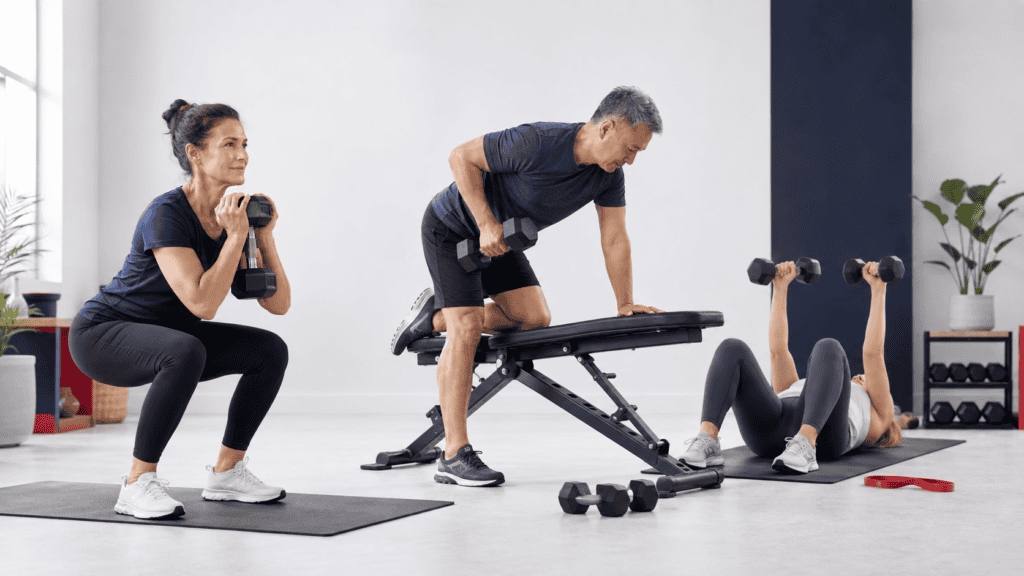
Beginners performing controlled full-body strength exercises with dumbbells in an accessible training environment
Start strength training with a simple full-body beginner plan. Learn exercises, sets, reps, RIR, rest, progression, home vs gym, and common mistakes.
Full body workout no equipment
Full body workout no equipment needed - It can be an excellent way to build muscles and stay fit. We’ll go through an example workout plan for beginners.

Practical decision guide

Six questions before you choose a plan

A useful plan fits the person and the situation—not only the exercise list.

1. Goal

What are you training for?

General strength, muscle growth, skill, sport performance, and a return to regular training can require different priorities.

2. Experience

What can you perform reliably?

Start with movements and instructions you can execute with control. Complexity is not a badge of progress.

3. Time

What fits your real week?

Count the sessions and the likely session length. A smaller plan you can repeat is more usable than a larger plan you cannot fit.

4. Equipment

Where will you train?

Choose a gym or home option that matches the tools you actually have. Equipment can change exercise selection without changing the purpose of the session.1

5. Recovery

Can you recover and repeat?

Review performance, perceived effort, sleep, soreness, and how the plan interacts with work, sport, and other activity.

6. Health context

Do you need individual guidance?

A generic plan cannot assess symptoms, medical readiness, an injury, rehabilitation needs, or clinician-directed restrictions.

General guideline context: WHO recommends that adults perform muscle-strengthening activity involving the major muscle groups on two or more days per week. That public-health target does not decide the correct exercises, workload, or progression for a particular person.2

Build the context

Go beyond the exercise list

Use these hubs when you need the training principles, movement guidance, or programming decisions behind a plan.

Strength training

Understand the fundamentals

Start with the principles that make a strength plan understandable before focusing on individual details.

Exercise technique

Learn the movements

Review exercise explanations when a plan includes a movement you do not yet understand or cannot perform comfortably.

Training programming

Understand the decisions

Learn how goals, variables, recovery, and progression connect when a plan needs to be built or adjusted.

Optional technique support

Use the Exercise Technique Checklist

Once you have chosen a plan, the free checklist can help you review setup, control, range of motion, breathing, and when to stop and reassess. It supports technique review; it does not make a generic plan individual or replace coaching or medical assessment.

Optional and secondary: choose the appropriate plan first.

About the educator

Created by Olaf Henning

Olaf explains training concepts as practical education, separates general examples from individual prescription, and connects each plan with the decisions needed to use it responsibly.

About Olaf

Frequently asked questions

Training-plan FAQ

What is the difference between a training plan and training programming?

A training plan is the concrete schedule you follow. Training programming is the decision process used to create, review, and adjust that schedule. Fitness Simply Explained uses this as an educational distinction, not as a claim that every coach or organization uses the terms identically.

Which plan should a beginner choose?

Start with the current beginner strength guide if you want a simple full-body structure. Before using it, check whether the exercises, workload, schedule, and equipment fit your present experience and recovery.

Can I train at home without equipment?

The category includes an existing no-equipment home workout. Home-based and elastic-band resistance training can improve relevant outcomes, and equipment type did not consistently determine results in the current ACSM evidence synthesis.1 Exercise difficulty and total workload still need to fit the person.

How often should I change my plan?

There is no universal date. Keep the structure while it still fits the goal, schedule, technique, recovery, and training response. Change a specific variable when you have a clear reason—not simply because the plan feels familiar.

Can a general plan replace individual coaching or medical guidance?

No. A general plan cannot assess symptoms, injury, medical readiness, rehabilitation needs, or sport-specific demands. Use qualified individual support when your situation requires it.

Evidence base

References

  1. Currier BS, D'Souza AC, Fiatarone Singh MA, et al. American College of Sports Medicine Position Stand. Resistance Training Prescription for Muscle Function, Hypertrophy, and Physical Performance in Healthy Adults: An Overview of Reviews. Medicine & Science in Sports & Exercise. 2026;58(4):851–872. doi:10.1249/MSS.0000000000003897. PubMed record.
  2. World Health Organization. WHO guidelines on physical activity and sedentary behaviour: at a glance. 2020. ISBN 978-92-4-001488-6. WHO publication page.

Claim/Source Mapping

Which source supports which claim?

The table maps scientific or health-related statements on this page. It does not map editorial definitions, SEO choices, interface copy, or internal-link strategy.

Claim or content Source Use and limitation
Resistance training can work through several modes, including home-based training and elastic bands; equipment type did not consistently affect outcomes in the ACSM synthesis. Reference 1 Supports the equipment and home-training statements. It does not establish that every exercise or generic plan suits every person.
Resistance-training prescription can be adjusted through variables such as frequency, load, volume, exercise type, and progression in line with the intended outcome. Reference 1 Supports the page’s adaptable-plan framing without prescribing one universal combination.
Adults should perform muscle-strengthening activities for the major muscle groups on two or more days per week. Reference 2 Used only as broad public-health context. It does not determine individualized exercise selection, workload, or progression.
The plan/programming distinction and the six-question fit check used on this page. Olaf Henning’s educational framework, informed by References 1–2 Clearly labeled as an organizing framework, not as a validated clinical screen or universal professional definition.

↔ On smaller screens, scroll the table horizontally.

Scope and safety: This hub provides general fitness education and adaptable examples. It does not diagnose symptoms, assess medical readiness, prescribe rehabilitation, or provide an individualized training plan. Stop and seek appropriate qualified guidance if exercise causes concerning symptoms, or if a medical condition, recent injury, rehabilitation plan, pregnancy-related consideration, or clinician-directed restriction changes what is safe or appropriate for you.
Scroll to Top