Exercise physiology hub

Exercise Physiology: How the Body Supports Movement

Understand the processes behind physical activity, starting with how working muscles obtain energy. This collection also includes two adjacent topics—muscle cramps and autogenic training—that call for a different kind of question.
Exercise-focusedEvidence-informedClear medical boundaries
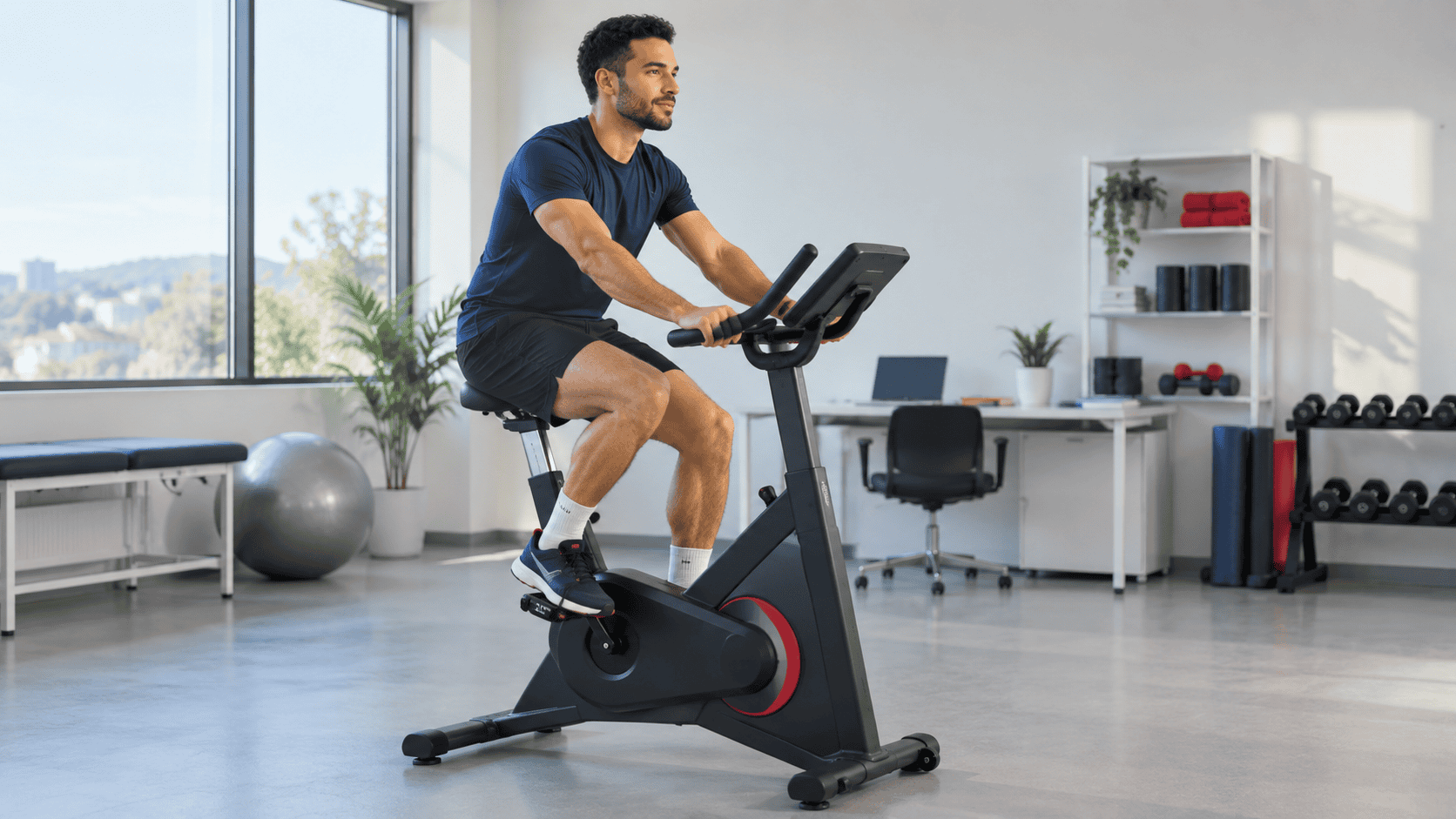
Adult cycling on a stationary exercise bike in a bright training space
Exercise physiology studies how the body works during physical activity. Image note: This image was AI-generated and is used for illustrative purposes.

Short answer

What does exercise physiology explain?

Exercise physiology examines how body systems supply and use energy during movement and how they respond to exercise. In working muscle, ATP is continually used and regenerated through interacting metabolic pathways.1

Those pathways do not switch on one at a time like separate gears. Their contributions vary with the task, intensity and duration; a fixed minute-by-minute chart would hide that overlap.2

Start here

The current core guide is Energy metabolism. Read it as an introduction to ATP and energy pathways; some claims in that older article still need their own separate update. This hub gives the more cautious overview.

Choose your question

One core route, two adjacent topics

The article cards below follow the category’s existing assignments. Their presence does not make every article a foundational exercise-physiology guide.

Core physiology

How is activity fueled?

Begin with energy metabolism. ATP is the immediate energy currency for muscle work, while different pathways contribute to its regeneration.1

Adjacent · symptoms

What about leg cramps?

The existing cramps article concerns a symptom with several possible contexts. Exercise-associated cramps should not be reduced to one universal cause or a blanket hydration fix.3

Adjacent · relaxation

Where does autogenic training fit?

Autogenic training is a relaxation practice discussed in stress-response research.4 Its article is a neighboring psychophysiology and lifestyle topic, not a core guide to exercise energy supply.

Current articles

Browse the physiology archive

The cards below are drawn from the existing category. Energy metabolism is the current core route; cramps and autogenic training remain adjacent topics.
What is autogenic training
What is autogenic training? Autogenic training is a practical relaxation and stress management method many people use worldwide.

Put the ideas in context

How to use physiology when thinking about training

Ask what the task demands

Consider what movement is being performed, how hard it is and how long it lasts. Energy pathways contribute together, and their relative contributions shift with the task.2

Keep separate questions separate

A guide to energy supply cannot diagnose a cramp or establish the effect of a relaxation method for an individual. Those questions have different evidence and safety boundaries.34

Olaf’s educational framework: start with the physiological process, then the movement task, then the person’s context. This is a way to organize learning, not a validated clinical algorithm or personal exercise prescription.

Continue learning

Connect the process to structure and programming

Anatomy

Locate the structures

Use the muscle-anatomy hub to understand the structures involved in movement.

Training programming

Plan the training task

Move from a physiological idea to goals, training variables and recovery context.

About the author

Who explains these topics?

Learn about Olaf Henning’s background and approach to evidence-informed fitness education.

Scope and safety

Educational information, not a diagnosis

This hub explains general exercise physiology. If cramps are recurrent, severe, unexplained or accompanied by other concerning symptoms, seek assessment from a qualified health professional rather than treating this archive as a diagnostic guide. Relaxation practices should not replace care for a health condition. The older linked articles have not been comprehensively revised as part of this hub.

Frequently asked questions

Exercise physiology in brief

What is exercise physiology?

It studies body responses to physical activity, including how working muscle uses and regenerates ATP and how these processes relate to the exercise task.1

Does one energy system take over at a fixed time?

No. Energy-producing pathways interact during exercise; their contributions depend on the task, intensity and duration. A universal switch time would be misleading.2

Are all articles here core exercise-physiology guides?

No. Energy metabolism is the current core route. Leg cramps and autogenic training are adjacent topics kept in the existing category archive.

Evidence and limits

References

  1. Smith JAB, Murach KA, Dyar KA, Zierath JR. Exercise metabolism and adaptation in skeletal muscle. Nature Reviews Molecular Cell Biology. 2023. PubMed record.
  2. Gastin PB. Energy system interaction and relative contribution during maximal exercise. Sports Medicine. 2001;31:725–741. PubMed record. Foundational review focused on maximal exercise; numerical timing is not generalized here.
  3. Miller KC, McDermott BP, Yeargin SW, Fiol A, Schwellnus MP. An evidence-based review of the pathophysiology, treatment, and prevention of exercise-associated muscle cramps. Journal of Athletic Training. 2022;57:5–15. PubMed record. Exercise-associated cramps; other cramp contexts are distinct.
  4. Seo E, Kim S. Effect of autogenic training for stress response: a systematic review and meta-analysis. Journal of Korean Academy of Nursing. 2019;49:361–374. PubMed record. Heterogeneous study contexts; no individual treatment claim follows.

Claim and source mapping

Hub statementSourceBoundary
Working muscle uses and regenerates ATP through interacting pathways.[1], [2]General mechanism; no fixed personal fuel share.
Energy systems do not switch sequentially at a universal time.[2]Maximal-exercise literature informs the principle; no timing figure transferred to all exercise.
Exercise-associated cramps do not have a single universal cause or blanket hydration fix.[3]Do not infer causes of an individual’s symptom or generalize to nocturnal or disease-related cramps.
Autogenic training is studied in stress-response contexts.[4]No efficacy, safety, or treatment promise for a particular visitor.

↔ On smaller screens, scroll the table horizontally.

Scroll to Top