Exercise Technique Explained: Make Better Movement Decisions
Good technique is not one universal pose. It is a repeatable way to perform an exercise that fits its purpose, your current ability, the equipment, the load, and the situation.
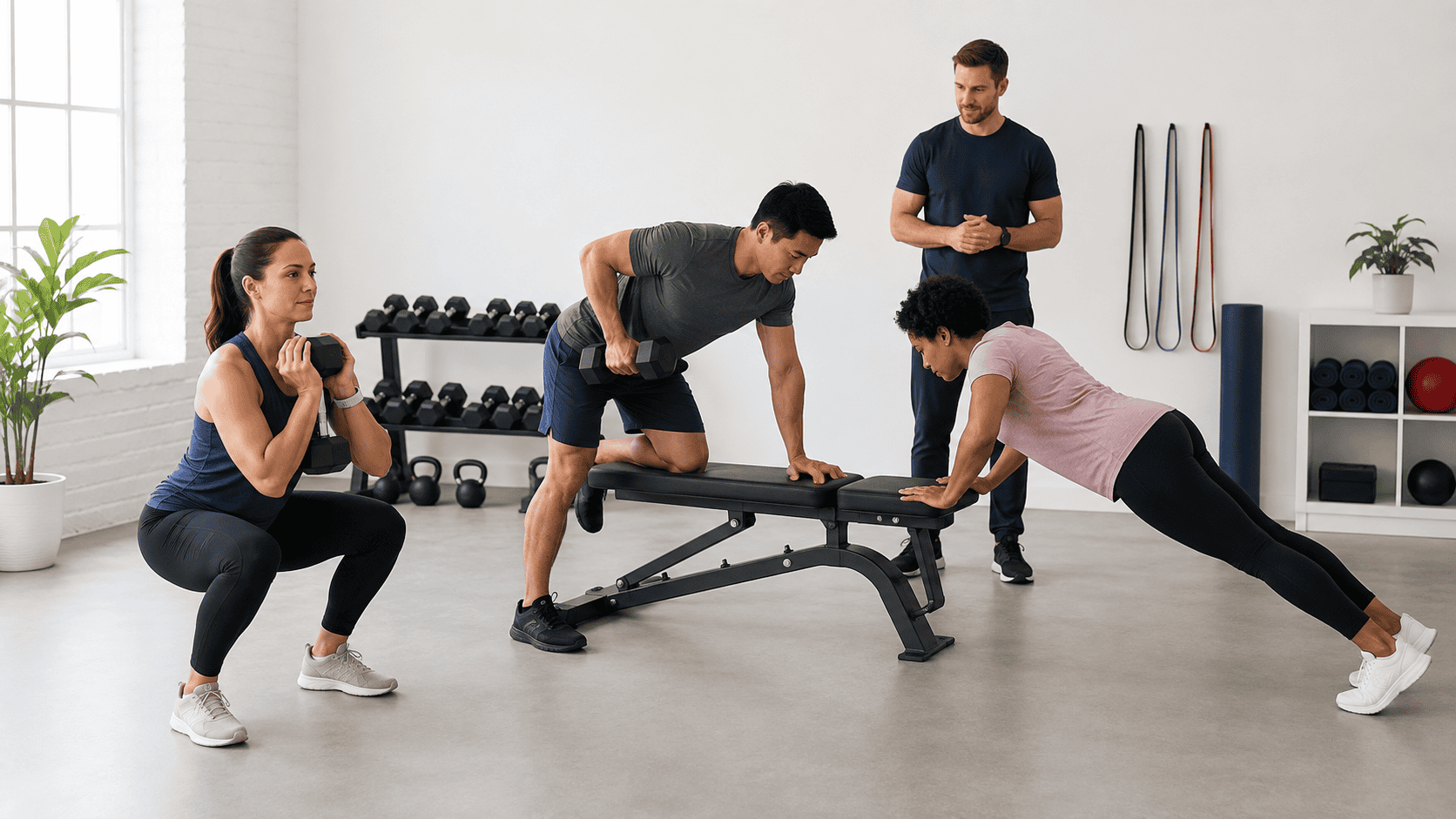
What is good exercise technique?
Good exercise technique is a movement strategy you can repeat with suitable control while the setup, range of motion, load, and effort match the goal of the exercise. It should be adaptable rather than copied rigidly from another person.
A useful technique review asks: What am I trying to train? Can I create a stable setup? Is the chosen range controllable? Does the movement remain intentional as fatigue rises? Is the variation appropriate for me today?
Exercise technique is more than “correct form”
A single cue or screenshot rarely tells the whole story. Technique becomes more useful when you connect the exercise goal with the person, setup, movement, loading, and feedback.
What is the exercise for?
The same movement can be organized differently for strength, muscle growth, skill practice, rehabilitation-oriented exercise, or sport preparation.
Can you repeat the setup?
A stable and repeatable setup makes it easier to compare repetitions, notice changes, and adjust the exercise without guessing.
Does it fit the person?
Body proportions, mobility, experience, symptoms, equipment, and confidence can change which variation or range is practical.
What feedback matters?
Use video, repetition quality, effort, balance, comfort, and progression as information—not as proof that every repetition must look identical.
Six decisions that shape exercise technique
Use these six decisions as a structured review. They are not a substitute for individual assessment, but they help turn vague advice such as “use perfect form” into questions you can actually answer.

Range of motion: useful, but not a universal depth rule
For generally healthy adults, the 2026 American College of Sports Medicine position stand reported that voluntary strength was enhanced when resistance training used a complete range of motion, alongside other prescription variables such as load, sets, exercise order, and frequency.1
A 2021 systematic review and meta-analysis of 16 studies also found that full-range training generally produced greater improvements in strength and lower-body hypertrophy than partial-range training, although the results varied by outcome, exercise, and the range being compared.2
Control does not mean every repetition must be slow
A 2015 systematic review and meta-analysis found similar muscle-hypertrophy outcomes across a broad range of repetition durations—approximately 0.5 to 8 seconds—when sets were performed to momentary failure. Very slow repetitions of 10 seconds or longer appeared less favorable in the studies available at the time.3
That does not make one tempo universally correct. The useful question is whether the pace helps you keep the intended range, position, and effort. A deliberately fast concentric action may fit power training, while a slower eccentric phase may help you learn a new movement or keep a lighter exercise challenging.
Technique can change as a set becomes harder
A 2024 meta-regression found that strength gains were similar across a wide range of estimated repetitions in reserve, while muscle hypertrophy tended to increase as sets ended closer to failure. The authors emphasized that the exact dose-response relationship remained uncertain.4
For technique review, this means you do not have to treat every small movement change as failure—but you should notice whether the exercise is still doing what you intended. End or modify the set when the load, fatigue, or speed no longer allows a useful repetition for the current goal.
- Reduce the load when the planned range repeatedly disappears.
- Use more external support when balance limits the target movement.
- Choose an easier variation when the setup cannot be repeated.
- Stop a set when you can no longer produce the intended repetition safely and deliberately.
How to review an exercise without chasing perfection
Use the sequence below before changing several cues at once. One useful adjustment is easier to evaluate than five corrections made simultaneously.
Define the purpose
Name the movement, muscle group, skill, or outcome the exercise is supposed to support.
Check the setup
Review equipment, grip, stance, support, and the position from which each repetition begins.
Choose the range
Use a range that remains controlled and relevant rather than forcing a depth or endpoint.
Watch one repetition
Look for the main path, balance, and joint positions instead of trying to monitor everything.
Match the load
Select resistance that allows the planned repetitions and effort without changing the task entirely.
Use useful feedback
Compare video, balance, effort, comfort, and consistency across sets rather than one frozen frame.
Change one variable
Adjust the load, range, support, tempo, or exercise variation—then reassess the result.
Progress gradually
Increase difficulty only after the current version is repeatable and still fits the goal.
Browse strength exercises by body region
The current library is organized by body region. Individual guides are being revised gradually to improve exercise purpose, setup, execution, anatomy, regressions, progressions, and safety boundaries.
Chest
Pressing and fly variations using body weight, dumbbells, barbells, cables, or machines.
Back
Rows, pulldowns, pull-up variations, and exercises for the trunk and back extensors.
Shoulders
Pressing, raising, rotation, and shoulder-blade-control exercises with clear setup guidance.
Trapezius
Exercises that involve scapular elevation, retraction, rotation, and upper-back loading.
Biceps
Curl variations with attention to grip, shoulder position, range, and resistance profile.
Triceps
Pressing and elbow-extension variations using free weights, cables, bands, or body weight.
Core and abs
Bracing, trunk flexion, anti-extension, and other core-focused exercise variations.
Glutes
Hip extension, abduction, squat, hinge, bridge, and lunge variations for the gluteal muscles.
Legs
Squat, hinge, lunge, leg-press, knee-extension, knee-flexion, and calf exercise guides.
Technique makes more sense when connected to training
An exercise guide is only one layer. Use the related hubs to understand why the movement was selected, how it is loaded, and which muscles and joints are involved.
Strength Training Explained
Connect exercise selection with sets, repetitions, effort, rest, and progression.
Strength Training for Beginners
Use a simple full-body framework with manageable variations and gradual progression.
Programming Strength Training
Understand how training variables and methods influence the role of each exercise.
Anatomy for Training
Connect movement with muscles, joints, leverage, and the function of the body region.
Technique advice cannot diagnose symptoms
Stop exercising and seek appropriate medical guidance for concerning symptoms such as exertional chest discomfort, fainting, or unreasonable breathlessness. Preparticipation screening guidance identifies these as examples that warrant medical clearance before starting or resuming exercise.5
Persistent, worsening, radiating, or otherwise concerning pain should not be managed by repeatedly changing technique cues online. Exercise education can help you ask better questions, but it does not replace an individualized medical, rehabilitation, or coaching assessment.
Review your exercise technique with more structure
Use ten practical checks for exercise purpose, setup, movement control, range of motion, loading, warning signs, and progression.
Exercise technique FAQ
What is good exercise technique?
Good technique is a repeatable movement strategy in which the setup, range, control, resistance, and effort fit the purpose of the exercise and the person performing it.
Is there one perfect form for every exercise?
No. Some features are important for a specific task, but stance, grip, range, equipment, and movement path can vary with body proportions, experience, goals, and current capacity. Technique should be structured without pretending every person must look identical.
Should every repetition be performed slowly?
No. A broad range of repetition durations can be effective for muscle growth, while very slow repetitions may become less useful in some contexts.3 Use a pace that preserves the intended movement and matches the training goal.
Is full range of motion always required?
Should I stop a set when my technique changes?
Small changes can occur as effort increases. Stop or modify the set when you can no longer perform a useful repetition for the goal—for example, when the planned range, balance, or position repeatedly disappears.
How can I check my own exercise form?
Start with the exercise purpose, then review setup, range, movement path, load, and effort. A short video from a useful angle can help, but compare several repetitions rather than judging one frozen frame.
When should I seek professional or medical help?
Seek appropriate help for concerning symptoms, persistent or worsening pain, major uncertainty after injury, or a need for individualized exercise selection. Exertional chest discomfort, fainting, and unreasonable breathlessness are examples that warrant medical clearance.5
References
- American College of Sports Medicine. American College of Sports Medicine Position Stand. Resistance Training Prescription for Muscle Function, Hypertrophy, and Physical Performance in Healthy Adults: An Overview of Reviews. Medicine & Science in Sports & Exercise. 2026. doi: 10.1249/MSS.0000000000003897. Official ACSM summary.
- Pallarés JG, Hernández-Belmonte A, Martínez-Cava A, Vetrovsky T, Steffl M, Courel-Ibáñez J. Effects of range of motion on resistance training adaptations: A systematic review and meta-analysis. Scandinavian Journal of Medicine & Science in Sports. 2021;31(10):1866–1881. doi: 10.1111/sms.14006. PubMed.
- Schoenfeld BJ, Ogborn DI, Krieger JW. Effect of repetition duration during resistance training on muscle hypertrophy: A systematic review and meta-analysis. Sports Medicine. 2015;45:577–585. doi: 10.1007/s40279-015-0304-0. Publisher page.
- Refalo MC, Helms ER, Trexler ET, et al. Exploring the dose-response relationship between estimated resistance training proximity to failure, strength gain, and muscle hypertrophy: A series of meta-regressions. Sports Medicine. 2024;54(9):2209–2231. doi: 10.1007/s40279-024-02069-2. PubMed.
- American Council on Exercise. Exercise Preparticipation Health-Screening Questionnaire for Exercise Professionals. Based on the ACSM preparticipation screening algorithm. Screening questionnaire.
Source Mapping
| Claim or content | Source |
|---|---|
| The 2026 ACSM position stand reported enhanced strength with complete range of motion among the resistance-training variables reviewed. | Reference 1 |
| Full-range training generally produced greater strength and lower-body hypertrophy than partial-range training in the 2021 meta-analysis, with outcome- and exercise-specific variation. | Reference 2 |
| A broad range of repetition durations can support hypertrophy, while extremely slow repetitions appeared less favorable in the available research. | Reference 3 |
| Strength gains were similar across a wide range of estimated repetitions in reserve, while hypertrophy tended to improve closer to failure; the exact relationship remained uncertain. | Reference 4 |
| Exertional chest discomfort, fainting, and unreasonable breathlessness are examples of symptoms that warrant stopping and seeking medical clearance. | Reference 5 |