Gaming & esports — what the evidence says
Fitness for Gamers: Exercises, Workout Plan & Esports Performance
Exercise can benefit gamers' general health and may improve some of the cognitive skills measured in esports research. A 2026 meta-analysis of randomized controlled trials found better scores for cognitive processing speed, operational accuracy, and executive-function or memory tasks after exercise interventions. Confidence in the findings was moderate for accuracy and low for the other outcome groups. That does not mean lifting weights automatically improves your aim, competitive rank, or match win rate—and it does not establish one best workout for every gamer.1
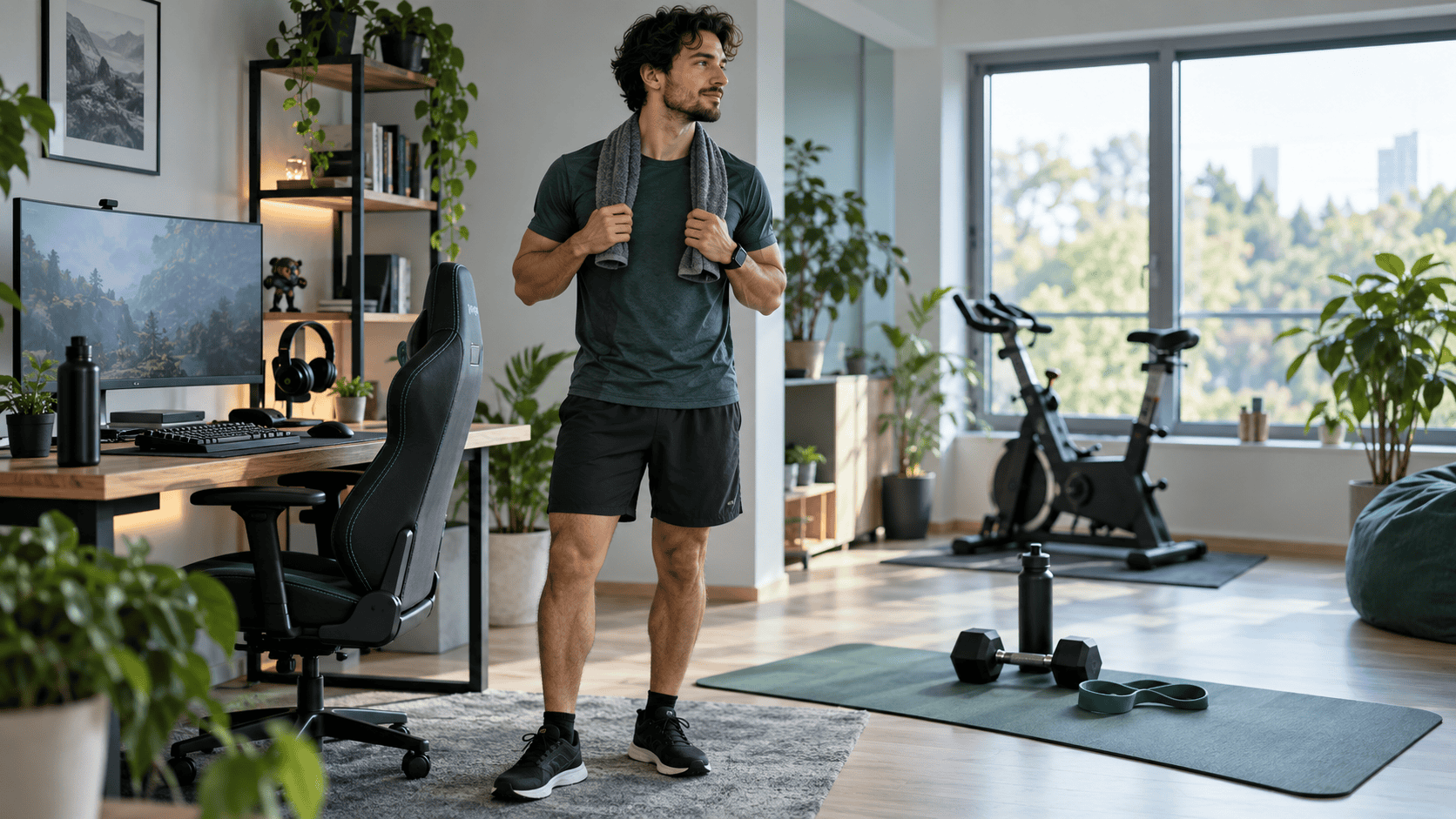
If you are an adult gamer looking to improve your fitness, you do not need a secret “esports workout hack.” A practical starting point is two full-body resistance-training sessions per week, together with regular aerobic activity or daily movement and fewer prolonged periods of sitting. These suggestions reflect general health and training guidance, not a validated esports-performance prescription.2,3
Research on gaming performance requires more caution: physical exercise may affect performance in certain cognitive, reaction-time, aiming, or game-like tests. The outcome depends on the participants, exercise program, game genre, and test. A better test score is not the same as winning more matches.1,4
Start with four movement patterns: a squat or lunge, a hip hinge, a push, and a pull.3
General resistance-training evidenceBuild gradually toward public-health activity guidance. Walking, cycling, and jogging are accessible options.2
General health guidanceIn one small esports trial, a six-minute walk helped selected planning tasks, but not match wins or kill-to-death ratio.5
Direct esports evidenceBrief physical activation is worth studying, but the optimal esports warm-up, dose, and timing are unknown.4
Direct evidence; dose unresolvedYou do not need a statistics or esports background to understand the findings. Open a group when you need a quick explanation of a term used later in the article.
1. Understanding the studies — 11 terms
2. Gaming terminology — 9 terms
3. Exercise, body and cognition — 6 terms
- The August 2026 meta-analysis included 10 randomized controlled trials and 503 esports players and found pooled improvements in processing speed, operational accuracy, and executive-function or memory outcomes.1
- Certainty was moderate for operational accuracy and low for cognitive speed and executive-function/memory outcomes.1
- A six-week HIIT trial with 83 young FPS gamers found gains in several game-like aiming/reaction measures; another eight-week trial with 28 esports players improved coordination and grip strength without clear gains in measured esports outcomes.8,9
- In one crossover trial, a six-minute walking break improved selected executive-function measures but not win rate or kill-to-death ratio.5
- Classical resistance training is well supported for general fitness, but it is not established as an isolated aim, rank, or match-performance booster.1,3
- Most direct esports intervention evidence comes from relatively young, often male populations; transferring it to other groups and game genres remains uncertain.1,4
What does research actually show about exercise and esports performance?
An August 2026 systematic review with meta-analysis pooled 10 randomized controlled trials involving 503 esports players. Its literature search extended through May 3, 2026. Studies included both single exercise sessions and training programs over several weeks.1
The pooled effect size for cognitive speed was a standardized mean difference (SMD) of 0.84 (95% confidence interval [CI] 0.50–1.18); for operational accuracy, it was 0.58 (95% CI 0.40–0.76). After a sensitivity analysis, the pooled effect for executive function and memory was 0.63 (95% CI 0.36–0.91). The SMD is a scale-standardized average difference—not a percentage increase or an in-game rank gain.1
The review rated certainty moderate for operational accuracy and low for the other two groups of outcomes. Different exercises, gaming genres, competitive levels, and tests were included. Better scores in a controlled test do not guarantee better match outcomes.1
Randomized exercise interventions among esports players, with selected cognitive and game-related outcomes.1
Operational accuracy showed a positive pooled estimate with moderate certainty.1
Cognitive speed and executive-function/memory outcomes were positive but rated low-certainty.1
Best exercise type, dose, timing, game genre, actual match transfer, and long-term rank.
| Research question | What was studied? | What was found? | Key limitation |
|---|---|---|---|
| Exercise and cognitive or esports-related performance | 10 randomized controlled trials, 503 participants; one-off sessions and programs lasting 4–8 weeks, including aerobic exercise, HIIT, resistance training, and movement-based video games.1 | Pooled improvements in processing speed, operational accuracy, and executive-function or memory tasks.1 | Moderate certainty for accuracy; low for other pooled outcomes. Interventions and tests varied. |
| Acute exercise | Systematic review of 12 experiments. Many single sessions lasted about 6–30 minutes, with different exercise types and intensities.4 | Individual trials reported benefits in reaction time, executive tasks, aiming or selected in-game measures.4 | Observed intervention durations do not define an optimal esports warm-up. |
| Six weeks of HIIT in FPS gamers | 83 participants aged 18–29 years; three sessions weekly, averaging about 26 minutes each.8 | Better results in selected flicking, tracking, decisions, reaction-time and shooting-accuracy measures.8 | Aim Lab and other controlled tests are not equivalent to competitive rank or wins. |
| Eight weeks of training | 28 esports athletes allocated to three groups.9 | Coordination and grip strength improved; measured esports-performance outcomes did not show clear between-group gains.9 | Small sample and uncertain gaming-performance transfer. |
| Six-minute walking break | 21 competitive FPS participants in a randomized crossover comparison of walking, passive rest, and continued play.5 | Some executive-function and processing-speed measures improved with walking.5 | No observed benefit in win rate or kill-to-death ratio. |
On smaller screens, swipe or scroll horizontally to view the complete table.
Exercise before or during gaming: Interesting, but not a magic potion
A May 2026 systematic review covered 12 experimental studies of acute and longer-term exercise in esports players. Several acute studies reported positive results in particular cognitive or esports-related tests. Sessions often lasted roughly 6–30 minutes and involved activities such as walking, cycling, treadmill exercise, intervals, or active video games (exergaming). The studies were heterogeneous.4
That range is not a scientifically validated universal 6–30-minute warm-up. Exercise modality, effort, testing method, and time before play differed, so the ideal protocol for an individual player is still unknown.1,4
In a small randomized crossover experiment involving 21 competitive first-person-shooter players, researchers compared continued gaming, passive rest, and a six-minute walk after approximately one hour of gaming. Some planning and processing-speed outcomes improved after walking, while match win rate and kill-to-death ratio did not.5
Long-term training: Positive signals, mixed evidence of gaming transfer
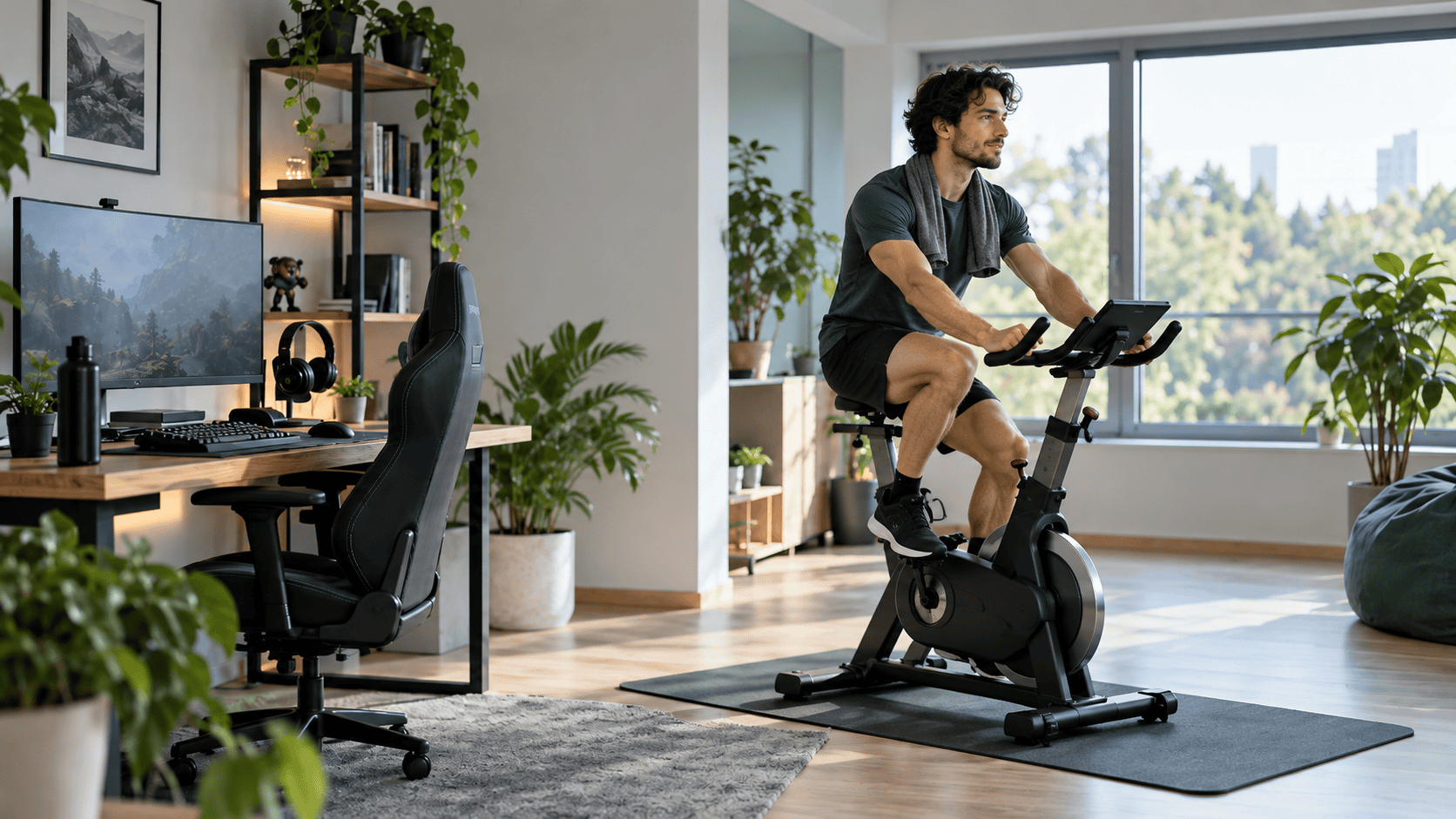
A six-week randomized study enrolled 83 young first-person-shooter gamers who were not exercising regularly. A high-intensity interval training (HIIT) program included three sessions per week, averaging around 26 minutes per session. The exercise group subsequently performed better on selected game-like measures of flicking, tracking, decision-making, reaction time, and shooting accuracy.8
Participants were 18–29 years old and predominantly men. Some outcomes were measured with Aim Lab and related standardized tasks. A better score there does not, by itself, establish improved team coordination, a higher competitive rank, or more match wins.8
In another randomized study involving 28 esports players over eight weeks, coordination and grip strength improved, but the assessed gaming outcomes did not show statistically clear group differences. A non-significant result does not prove a true zero effect; the small sample limits conclusions in either direction.9
Does strength training specifically improve gaming performance?
Resistance training has a much stronger research base for general strength and physical function than for winning games. A 2026 American College of Sports Medicine position stand summarized 137 systematic reviews involving more than 30,000 participants. Progressive resistance training improved strength, muscle size, power, muscular endurance, balance, and several physical-function outcomes in healthy adults.3
Whether resistance training specifically improves aim, rank, or match wins is a different question. The esports meta-analysis combined a range of exercise interventions. The findings cannot be used to isolate a reliable effect of traditional weight training on competitive game performance.1
What this means: Resistance training is useful as part of general fitness for gamers. It is not currently a proven aim or rank booster.
Which exercises make sense for gamers?
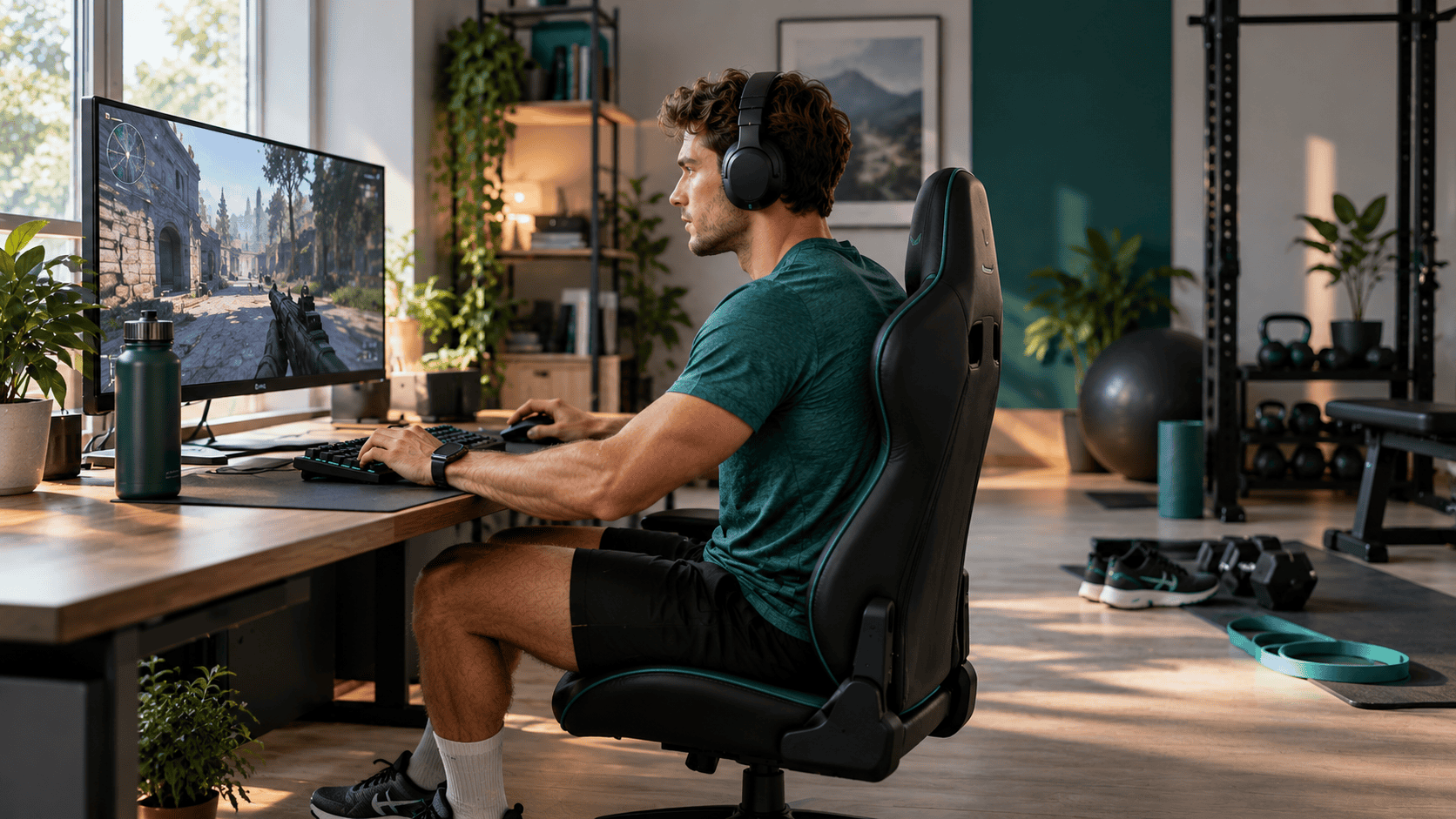
There is no evidence-based ranking of the best weightlifting exercises specifically for gamers. For healthy adults starting strength training, simple movement patterns are a useful way to build a manageable routine: a knee-dominant movement, a hip hinge, a push and a pull. Exercises and resistance can be progressed gradually; general training evidence supports multiple exercise modalities.3
| Movement pattern | Exercise options | Simple starting example | How to interpret the evidence |
|---|---|---|---|
| Knee-dominant movement | Goblet squat, squat, split squat or step-up | For example: 2 controlled sets of 8–12 repetitions | A practical beginner choice, not a tested best program for gamers. |
| Hip-dominant movement | Romanian deadlift, basic hip hinge or hip thrust | For example: 2 controlled sets of 8–12 repetitions | General resistance training; no isolated gaming-performance effect established.3 |
| Push | Push-up, dumbbell bench press or chest press | For example: 2 controlled sets of 8–12 repetitions | Practical exercise choice; not a validated esports-specific movement. |
| Pull | Cable row, machine row or dumbbell row | For example: 2 controlled sets of 8–12 repetitions | A practical option; no row variation has been proven to raise competitive rank. |
| Optional accessory | Calf raise, loaded carry, trunk exercise or another movement suited to your goal | For example: 1–2 controlled sets | Optional general-fitness component. |
On smaller screens, swipe or scroll horizontally to view the complete table.
The example of 8–12 repetitions is an accessible programming choice—not a proven optimal repetition range for esports performance. The scientific basis here is resistance training for healthy adults in general, not a gamer-specific dose.3
A simple workout plan for gamers
The World Health Organization (WHO) recommends that adults work toward 150–300 minutes of moderate-intensity aerobic activity, or 75–150 minutes of vigorous-intensity activity, or a suitable combination each week. It also recommends muscle-strengthening activities involving major muscle groups on at least two days per week and limiting sedentary time. These are health recommendations, not an esports-specific performance dose.2
For a generally healthy adult gamer, the following is one possible weekly framework. Adapt it to experience, time, health status, and recovery; it is not a personalized prescription.
| Day | Example activity | Primary purpose | Evidence context |
|---|---|---|---|
| Monday | Full-body resistance training; around four or five exercises | Strength and general physical function | General resistance-training evidence.3 |
| Tuesday | Brisk walk, cycling or another aerobic activity | Aerobic fitness and movement time | General WHO health guidance.2 |
| Wednesday | No planned training required; ordinary daily movement | Manage recovery and daily routine | Practical scheduling choice, not a studied esports dose. |
| Thursday | Full-body resistance training | Strength and general physical function | General resistance-training evidence.3 |
| Friday–Sunday | Distribute additional aerobic or everyday activity around your schedule | Build weekly activity volume | Progress gradually toward WHO guidance.2 |
On smaller screens, swipe or scroll horizontally to view the complete table.
No standardized esports warm-up has been validated as the universal best approach. If you want to try brief movement before playing, an easy walk or some comfortable cycling are reasonable personal experiments. They should not be advertised as proven to optimize aim or rank.1,4
Practical interpretation: if activation is your goal, avoid turning it into a bout that leaves you unhelpfully fatigued. This is a coaching judgment, not a scientifically established threshold.
Movement breaks while gaming: What has actually been studied?
Instead of claiming that every player must stand up on one magically precise schedule, consider the trial itself. 21 competitive first-person-shooter players completed three randomized conditions: continued play, six minutes of passive lying rest with eyes open, or a six-minute walk after roughly an hour of gaming. Walking improved some executive-function and planning measures, but not win rate or kill-to-death ratio.5
Independently of esports, the WHO recommends limiting sedentary time and replacing some of it with physical activity. There is not yet a scientifically established, one-size-fits-all break frequency for gaming sessions.2
Are gamers and esports players automatically unhealthy?
Are esports players necessarily less healthy? The evidence does not support that blanket statement. A 2026 systematic review and meta-analysis included 53 studies and 86,652 people. In initial pooled comparisons, no statistically clear differences appeared across several measures including physical activity, body mass index, sleep duration, anxiety, depression, stress and grip strength. This does not establish that the groups were identical.10
The same review found small associations with sedentary behavior (r = 0.17), body mass index (r = 0.09), and gaming disorder (r = 0.10). These correlations do not identify cause. Sensitivity and subgroup analyses also identified some outcome-specific differences, including body fat in nonprofessional players; the overall picture is more nuanced than “gamers are unhealthy.”10
Many underlying studies were cross-sectional and diverse in their participants and methods. Results about competitive esports participation should not be generalized automatically to all recreational gamers.10
What we deliberately do not promise as “gamer fitness”
No. Resistance training is well established for physical strength and function, but a direct gaming transfer has not been isolated reliably.1,3
One six-week HIIT trial was positive on selected tasks; other studies show more mixed results. Universal superiority has not been established.1,8,9
Competitive performance combines mechanical skill, strategy, decision-making, teamwork and many game-specific demands. A test measures only part of that picture.8,11
The health review does not justify that oversimplification. Interpretation depends on the outcome, population and study design.10
How much resistance, aerobic exercise and everyday movement fits your life depends on your current ability, goals, recovery, and available time. For more individualized support, these related services may be useful.
Online personal training
Individualized programming, progress reviews and exercise-technique feedback designed around your circumstances.
Explore online coachingHolistic Cloud for goals and routines
Holistic Cloud is an English-language self-development app for goals, reflection and continuity across multiple life dimensions. It is not a workout-program generator or a clinical therapy service.
Explore Holistic CloudTransparency: These links lead to independent external services within the creator's connected business and project network. They are not part of the free Fitness Simply Explained article.
Frequently asked questions about fitness for gamers
Does exercise actually help gaming?
Among esports players, randomized trials and a meta-analysis show improvements in selected cognitive and game-like test outcomes. Certainty is moderate to low depending on the outcome; a test advantage does not prove a higher rank or more match wins.1
What are the best exercises for gamers?
No special ranking of strength exercises has been validated for gaming performance. For general fitness, controlled squat or lunge, hip hinge, push and pull patterns are practical options—not an esports-specific optimum.3
How often should gamers lift weights?
For generally healthy adults, muscle-strengthening activity on at least two days a week is consistent with WHO guidance, and regular progressive resistance training is supported by ACSM evidence. This is not a validated esports dose.2,3
Can strength training improve reaction time or aim?
An isolated cause-and-effect benefit of conventional resistance training for aim or competitive rank has not been established. The esports trials pooled different types of physical activity.1
Is HIIT especially good for esports players?
A six-week randomized trial in young FPS players improved several game-like measures after HIIT. The broader evidence does not establish HIIT as the universally best method across game genres or populations.1,8
How long should I move before gaming?
No optimal pre-gaming protocol is known. Acute exercise interventions in a 2026 review often lasted about six to 30 minutes, but this observed range is not an evidence-based universal dosage recommendation.4
Do movement breaks during gaming help?
One small crossover trial found that a six-minute walk improved some executive-function outcomes but not win rate or kill-to-death ratio. WHO guidance separately recommends reducing sedentary time.5,2
Are esports players less healthy than everyone else?
A 2026 meta-analysis did not identify universally poorer health across assessed outcomes, but found small associations with sedentary behavior, BMI and gaming disorder. Observational data cannot establish causation.10
Conclusion: Being fit makes sense; gaming performance remains game-specific
The evidence is more informative than simply saying “exercise is healthy.” A 2026 meta-analysis of randomized trials suggests that exercise interventions can improve selected cognitive and game-related test outcomes in esports players. But the certainty varies from moderate to low, studies are heterogeneous, and actual match or rank outcomes are not always measured.1
For practical training, prioritize general physical health and fitness first. A manageable full-body resistance program, aerobic or everyday activity, and fewer prolonged sitting periods are reasonable foundations. A short pre-gaming movement routine can be tried, but it should not be sold as a validated performance hack.2,3
Competitive esports performance includes far more than fitness: task-specific motor skill, decision-making, tactical understanding, perception, and game practice all matter.11
Written by Olaf Henning, M.Sc. Clinical Exercise Science, M.A. Sports Science, B.Sc. Sport and Performance, a German university-trained exercise and sports scientist. Read more about the author and qualifications.
This article is general educational information, not individualized exercise programming or a substitute for medical assessment, diagnosis, or treatment.
Source mapping: Which research supports each claim?
The mapping below distinguishes the supporting evidence from the limits of what each source establishes.
| Main claim | Primary source | Important qualification |
|---|---|---|
| Exercise interventions improved pooled esports-related cognitive test outcomes.1 | Sun et al. (2026) | 10 randomized controlled trials / 503 participants; certainty moderate for accuracy, low for two other groups; outcomes vary. |
| Acute exercise often showed positive signals; many study sessions lasted about 6–30 minutes.4 | Wachholz et al. (2026) | Systematic review of 12 experiments; observed durations are not optimal protocol advice. |
| Six weeks of HIIT improved selected FPS-like task measures.8 | Tang et al. (2025) | 83 young players; game-like tests and Aim Lab are not identical to competitive success. Included in later meta-analysis. |
| Eight weeks of exercise improved physical rather than clearly measured esports outcomes.9 | Wachholz et al. (2025) | Small randomized trial with 28 participants. |
| Six-minute walking break improved executive tasks but not win rate or KDR.5 | DiFrancisco-Donoghue et al. (2021) | 21 esports players; randomized crossover trial. |
| Esports participation is not uniformly linked with poorer health; some small correlations exist.10 | Tang et al. (2026) | 53 studies / 86,652 people; observational studies dominate; limited causal inference. |
| Adults should build weekly aerobic activity, strengthen major muscle groups at least twice weekly and limit sitting.2 | WHO (2020) | General public-health guideline, not an esports-specific performance protocol. |
| Progressive resistance training benefits strength, muscular outcomes, and physical function.3 | ACSM (2026) | 137 systematic reviews; healthy adult data, not specific evidence of better aim or rank. |
| Esports performance has multiple technical and cognitive dimensions.11 | Nagorsky & Wiemeyer (2020) | Research on the structure of performance, not evidence for an exercise intervention. |
On smaller screens, swipe or scroll horizontally to view the complete table.
References
- Sun H, Yao J, Zhu Y. Exercise interventions and multidimensional cognitive function in esports players: a systematic review and meta-analysis of randomized controlled trials. Front Psychol. 2026;17:1910084. DOI: 10.3389/fpsyg.2026.1910084. PMID: 42666305.
- World Health Organization. WHO guidelines on physical activity and sedentary behaviour. Geneva: World Health Organization; 2020. ISBN: 978-92-4-001512-8. WHO.
- Currier BS, D'Souza AC, Fiatarone Singh MA, Lowisz CV, Rawson ES, Schoenfeld BJ, et al. American College of Sports Medicine Position Stand. Resistance Training Prescription for Muscle Function, Hypertrophy, and Physical Performance in Healthy Adults: An Overview of Reviews. Med Sci Sports Exerc. 2026;58(4):851–872. DOI: 10.1249/MSS.0000000000003897. PMID: 41843416.
- Wachholz F, Coenen F, Zhang M, Heidenreich H. Effects of Acute and Chronic Physical Exercise on Esports Performance: A Systematic Review. Sports Med Open. 2026;12(1):56. DOI: 10.1186/s40798-026-01034-9. PMID: 42174296.
- DiFrancisco-Donoghue J, Jenny SE, Douris PC, Ahmad S, Yuen K, Hassan T, et al. Breaking up prolonged sitting with a 6 min walk improves executive function in women and men esports players: a randomised trial. BMJ Open Sport Exerc Med. 2021;7:e001118. DOI: 10.1136/bmjsem-2021-001118.
- World Health Organization. Gaming disorder. International Classification of Diseases (ICD-11): Questions and answers. WHO: Gaming disorder
- Diamond A. Executive functions. Annu Rev Psychol. 2013;64:135–168. DOI: 10.1146/annurev-psych-113011-143750. PMID: 23020641.
- Tang D, Zhang X, Ho RWK, Choi SM, Ye Z, Campbell MJ, et al. Effect of Physical Exercise on Esports Performance in First-Person Shooter Gamers: A Six-Week Randomized Controlled Trial. Sports Med Open. 2025;11(1):162. DOI: 10.1186/s40798-025-00970-2. PMID: 41444460.
- Wachholz F, Gamper N, Schnitzer M. An 8-week physical exercise intervention for e'athletes improves physical performance rather than short-term esports performance parameters - a randomized controlled trial. Front Sports Act Living. 2025;6:1504205. DOI: 10.3389/fspor.2024.1504205. PMID: 39906318.
- Tang D, Liu J, Gou P, Zhang X, Liu C, Ma R, et al. Association Between Esports Participation and Health: A Systematic Review and Meta-analysis. Sports Med Open. 2026;12(1):108. DOI: 10.1186/s40798-026-01083-0. PMID: 42525214.
- Nagorsky E, Wiemeyer J. The structure of performance and training in esports. PLoS One. 2020;15(8):e0237584. DOI: 10.1371/journal.pone.0237584.