
Exercise technique · Chest exercises
Learn a controllable flat dumbbell bench press—from getting the weights into position to choosing a useful range of motion—and understand what exercise research can and cannot tell us.
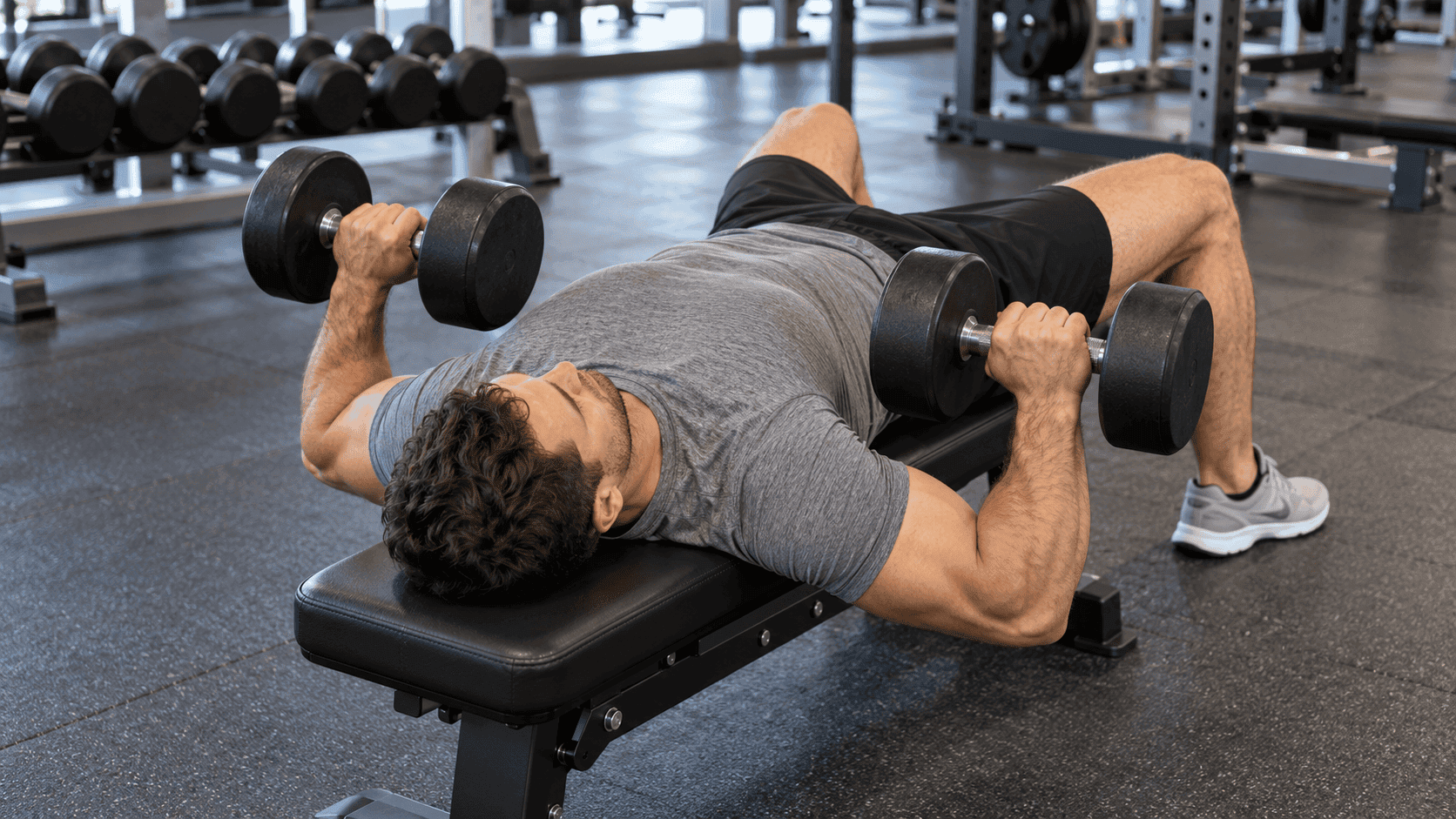
Short answer: how do you do a dumbbell bench press?
Lie on a stable, flat bench with your feet supported. Start with one dumbbell in each hand above your chest, your wrists roughly aligned with your forearms, and your shoulders supported by the bench. Lower the weights in a controlled arc to a depth you can manage comfortably, then press them back up without throwing your body or crashing the dumbbells together.1
The movement primarily involves the pectoralis major (chest), anterior deltoid (front of the shoulder), and triceps brachii (back of the upper arm). Their contributions vary with the exercise setup and task.2
Which muscles does the dumbbell bench press work?
Chest: The pectoralis major contributes to moving the upper arms across the body during the press. Front shoulders: The anterior deltoid assists the pressing movement. Triceps: The triceps brachii extends the elbows as the weights move upward. Other muscles help coordinate and stabilize the movement, but activation does not mean each muscle contributes equally.2
Researchers sometimes use electromyography (EMG), a measurement of electrical signals associated with muscle activity, to compare exercises. EMG does not directly measure muscle force, muscle growth, or the probability of injury. A different EMG signal is not, by itself, evidence that one press builds more muscle.3
How to perform the flat dumbbell bench press
These steps are practical coaching cues, not a claim that one identical joint angle is safest for every person. Practice the setup with manageable dumbbells before increasing the load.1
Set up the bench and weights
Choose a stable, flat bench. Sit with the dumbbells under control near your thighs. Place both feet securely on the floor or suitable supports. Use assistance when handling heavier weights.
Get into a stable starting position
Lie back deliberately and bring the weights over your chest without swinging them. Keep your head and upper back supported, your hands wrapped securely around the handles, and your wrists close to neutral.
Lower with control
Bend the elbows and let the dumbbells descend to either side of the chest. Choose a comfortable elbow path and a depth that you can control without an abrupt shoulder stretch, bounce, or loss of balance.
Press and finish the set
Press both weights back upward while keeping the wrists supported over the forearms. Finish each repetition deliberately; the dumbbells do not need to collide. To end, ask for help if needed and return the weights to a secure position instead of dropping them.
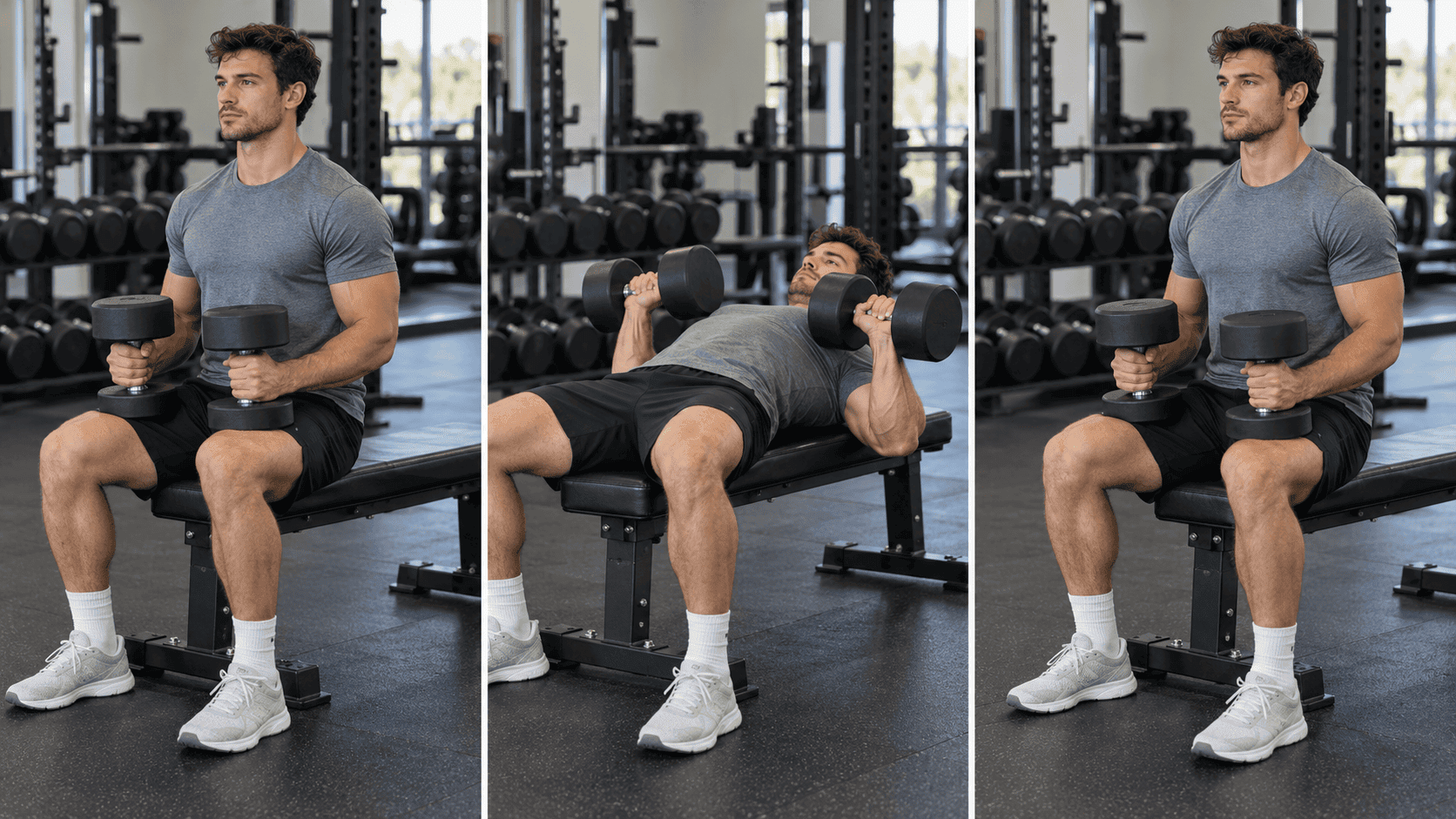
Breathing cue: for ordinary submaximal sets, exhaling during the press and inhaling during the lowering phase is one workable pattern. Breathing strategies may differ for higher-load lifting and individual health needs.
Where should your elbows, shoulders, and wrists go?
Keep your upper back supported and your shoulder position reasonably steady on the bench. Rather than forcing your elbows either tightly against your ribs or directly out to the sides, use a path that lets the forearms remain controllable and the shoulders move without provoking symptoms. A slightly angled or neutral-grip hand position may feel more natural to some lifters; there is no proven universal angle that eliminates injury risk.1
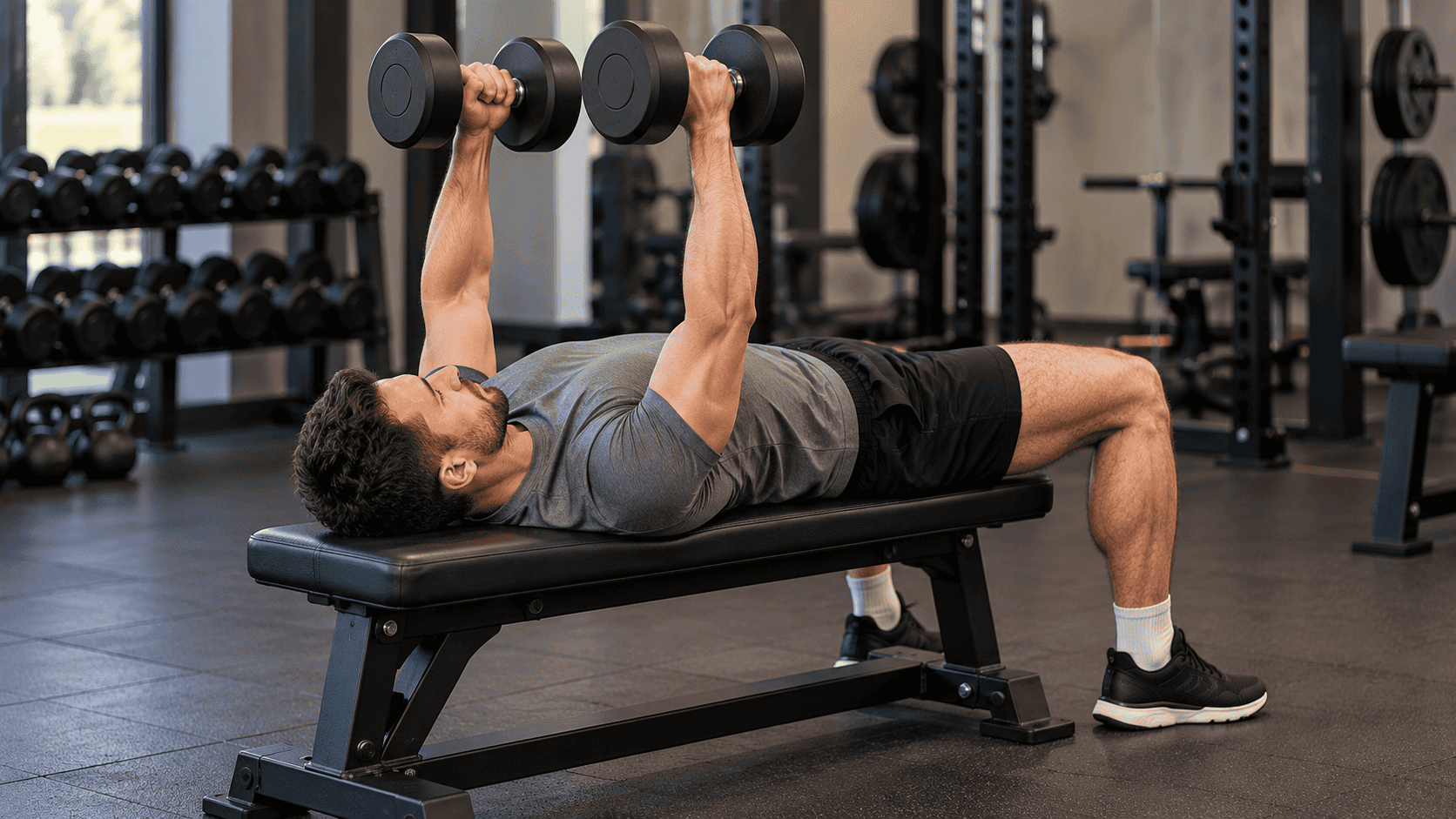
A 2024 laboratory study modeled shoulder-joint forces during barbell bench-press variations. Changing grip width and shoulder-blade position altered modeled loading, but the research included just ten experienced lifters, did not follow injury outcomes, and did not test the dumbbell press. It cannot establish a single injury-proof dumbbell technique.4
What if your shoulder hurts?
Do not force a painful range, heavy load, or grip because an online diagram calls it “correct.” Stop or adjust the exercise, and seek individualized professional assessment for persistent, worsening, or concerning symptoms. General technique guidance is not a diagnosis.
Common mistakes—and practical fixes
The aim is a repeatable pressing pattern, not an aesthetically identical repetition for everyone.
- Using weights you cannot start or finish safely: Choose a lighter pair, use a trained spotter, or switch to a setup with easier entry and exit.
- Letting wrists fold backward: Adjust your grip so the handle sits securely over the forearm rather than creating an exaggerated wrist bend.1
- Dropping into an uncontrolled bottom position: Slow the descent and use the range you can control today.
- Moving the hands too far apart or together just to mimic a picture: Allow a practical elbow path and keep both weights under deliberate control.
- Bouncing or slamming the dumbbells together: Finish the press without using impact as your endpoint.
- Confusing discomfort with productive effort: Reassess load and range when the movement provokes symptoms instead of treating pain as evidence of a better workout.
Dumbbells vs. a barbell—and what about a stability ball?
Dumbbells allow each hand to move independently. In a small study of 12 resistance-trained men, a one-repetition maximum (the heaviest load lifted once) was lower in the dumbbell chest press than in the barbell press. Chest and front-shoulder EMG did not differ detectably between conditions, while triceps EMG was lower with dumbbells. These are acute measurements, not a direct comparison of long-term muscle growth or safety.2
The broader 2026 American College of Sports Medicine (ACSM) evidence overview does not support the idea that one particular resistance-training equipment type is required for healthy adults to gain strength or muscle. Appropriate loading, consistent practice, and progression matter more than declaring one chest-press tool universally best.5
A stability ball (Swiss ball) is not the default surface for this tutorial. A small laboratory study of 16 healthy men found no significant difference in measured EMG activity between dumbbell chest pressing on a bench and a Swiss ball under the tested conditions. It did not show that the ball improves muscle development or that balancing weights on it is equally safe for everyone. A stable bench removes one avoidable setup challenge when learning and loading the press.6
Swipe or scroll horizontally to view the full comparison table.
| Variation | What changes | Practical consideration |
|---|---|---|
| Flat dumbbell bench press | Independent hand paths; bench supports the upper body. | Useful general-purpose chest press when you can control setup, weights, and range. |
| Flat barbell bench press | Both hands share a fixed bar; the movement and maximum load may differ.2 | A separate exercise, not an interchangeable technique guide. Compare the barbell guide. |
| Dumbbell floor press | The floor limits how far the elbows can travel behind the torso. | A shorter-range variation if the reduced depth suits your purpose; not a guaranteed solution to shoulder symptoms. |
| Swiss-ball dumbbell press | Introduces an unstable support surface. | Not necessary for general chest training; EMG data do not establish superior outcomes.6 |
How many sets and reps should you do?
There is no dumbbell-bench-press-specific number that everyone must follow. As an illustrative starting point, a generally healthy beginner might try one or two manageable sets of roughly 8–12 controlled repetitions within a balanced strength-training routine, then adjust based on ability, recovery, and goals. This example is coaching guidance, not a single protocol proven best for everyone.
For healthy adults, the ACSM's 2026 overview supports progressive resistance training and emphasizes that specific equipment and routinely training to failure are not essential to improve typical outcomes. Build repetitions or load gradually while preserving control and the intended movement.5
New to resistance training? Start with the beginner strength training guide, and use the Exercise Technique hub to explore the broader decision framework.
A simple way to review your technique
Use the free Exercise Technique Checklist to consider setup, control, range, loading, and progression. The checklist is educational—not a substitute for individual assessment.
Explore the free technique checklistFrequently asked questions
Is the dumbbell bench press better for chest growth than the barbell bench press?
There is no good basis for declaring it universally better. A small acute comparison measured EMG and one-repetition maximum, not months of hypertrophy. Choose a version you can train progressively and consistently.25
How far should I lower the dumbbells?
Use a deliberate range in which your shoulders and wrists remain comfortable and you can reverse direction under control. Bench height, anatomy, grip, and training goal affect the practical stopping point. There is no universally correct point that guarantees safety.
Should dumbbells touch at the top?
No. Bring the weights up under control; they can finish close together without striking each other. A collision is not needed to complete a repetition.
Can I press on a Swiss ball instead of a bench?
You can create that variation, but it is not required for chest training. A small study found similar acute muscle-activity measurements on the two surfaces, without demonstrating superior long-term benefit or equal safety. For this guide, a stable bench is the straightforward default.6
About the author
Olaf Henning is a German university-trained exercise scientist and sports scientist. He holds an M.Sc. in Clinical Exercise Science, an M.A. in Sports Science, and a B.Sc. in Sport and Performance. This article provides general evidence-informed exercise education, not personalized medical advice or injury treatment. Learn more about Olaf.
For additional exercises, see the Chest Exercises collection.
References
- American Council on Exercise. Chest Press. ACE Exercise Library. Exercise instructions. Practical technique reference; not a clinical outcome study.
- Saeterbakken AH, van den Tillaar R, Fimland MS. A comparison of muscle activity and 1-RM strength of three chest-press exercises with different stability requirements. J Sports Sci. 2011;29(5):533–538. doi:10.1080/02640414.2010.543916.
- Vigotsky AD, Halperin I, Lehman GJ, Trajano GS, Vieira TM. Interpreting Signal Amplitudes in Surface Electromyography Studies in Sport and Rehabilitation Sciences. Front Physiol. 2018;8:985. doi:10.3389/fphys.2017.00985.
- Noteboom L, Belli I, Hoozemans MJM, et al. Effects of bench press technique variations on musculoskeletal shoulder loads and potential injury risk. Front Physiol. 2024;15:1393235. doi:10.3389/fphys.2024.1393235.
- Currier BS, D'Souza AC, Fiatarone Singh MA, et al. American College of Sports Medicine Position Stand: Resistance Training Prescription for Muscle Function, Hypertrophy, and Physical Performance in Healthy Adults—An Overview of Reviews. Med Sci Sports Exerc. 2026;58(4):851–872. doi:10.1249/MSS.0000000000003897.
- Uribe BP, Coburn JW, Brown LE, et al. Muscle activation when performing the chest press and shoulder press on a stable bench vs. a Swiss ball. J Strength Cond Res. 2010;24(4):1028–1033. doi:10.1519/JSC.0b013e3181ca4fb8.
Study results describe the populations and conditions measured. They are not individual predictions or guarantees of training results or injury prevention.